Independence, MO · Garage Door Service
Roller Replacement for Raytown's 1960s Garage Doors
Raytown homes built around 1963 often run original steel rollers on worn track. We replace them from our Independence shop, 9 miles out, with parts sized for that era.
- Repairs & new doors
- Springs & openers
- Serving 8 nearby communities
How Long You Are Without the Door
Raytown is a town of about 12,651 households, which keeps this a steady but not constant call for us. We're not stationed in Raytown - we run the job from Independence, about 9 miles away - so we don't pretend to a walk-down-the-street response time. What we can tell you is that roller jobs are usually quick once a truck is on site: the door comes apart section by section, not all at once, so most of these repairs finish in a single visit rather than stretching into a return trip for parts. The exception is a track bent badly enough from a seized roller that we need to true it up or swap a section, which adds time to the same visit rather than a second one.
What You Are Seeing
A worn roller rarely fails quietly. You'll hear a grinding or clunking as the door travels, usually worse at the same spot in the track every time - that's the flat spot on the roller wheel itself. On older steel rollers, common in homes built around 1963 like a lot of Raytown's stock, you'll sometimes see metal shavings on the floor near the track before you hear anything. If the door jerks or hesitates partway up, one or more rollers may have left the track entirely, riding on the edge of the rail instead of inside it. None of this means the opener is failing - it's almost always the roller and track, not the motor.
What Causes It Around Here
Raytown's housing stock centers on a 1963 median build year, which puts a lot of doors in this town on their second or third roller set by now, often still riding the original steel stems and tracks from a build era long before nylon rollers were standard. Steel rollers wear faster and louder than sealed nylon ones, and in a cold-moderate climate like this region's, winter stiffens old grease in the bearings, which accelerates flat-spotting on a roller that's already past its life. A door that sits in an unheated or uninsulated garage - common in houses from this build period - sees more of that cold-stiffening effect than a newer, better-sealed bay.
How We Fix It
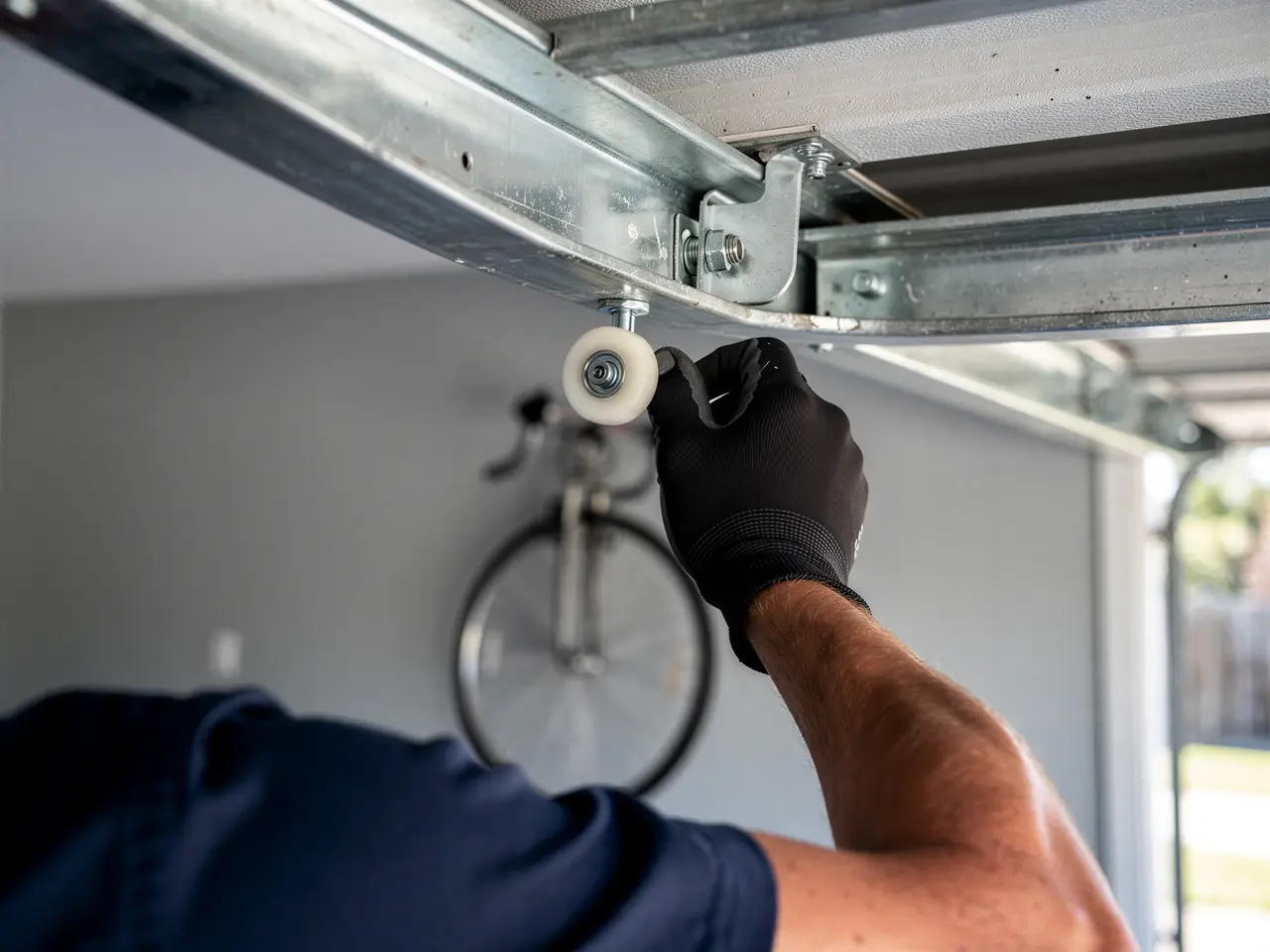
We pull the old rollers one at a time, working the door up in stages so it stays supported, and check the track alignment as we go since a track that's been riding a flat-spotted roller for months is often bowed slightly even if it looks straight. We size replacement rollers to the stem length and track gauge you've got - a lot of Raytown's 1960s-era doors use a narrower track than what's standard on new builds, so we don't show up with a one-size kit and hope. If the track itself is bent beyond a clean adjustment, we'll say so before we quote the roller work, because replacing rollers on a track that's still out of true just buys you the same noise back in a year.
The DIY Question
Swapping a roller or two is within reach for a homeowner comfortable with basic tools, as long as the door is down and the springs are left alone - springs are not a DIY repair, full stop. The harder part on an older Raytown door is usually not the roller itself but figuring out whether the track needs attention too, since a worn roller and a slightly bent track often show the same symptoms and only one of them is a bolt-on fix. If you're not sure which you're looking at, it's worth a call before you buy parts that don't solve the actual problem.
What Can Go Wrong
The biggest risk in this kind of job is a cable or extension spring under tension letting go while someone's hands are near the track - that's the point where a DIY roller swap turns into an ER trip, not a bruised thumb. On the mechanical side, forcing a door up and down on a roller that's jumped the track can bend the track enough that it needs replacing instead of adjusting, which turns a $20 part into a bigger job. We'll also tell you plainly when a roller swap isn't worth doing: if the door itself is original to a 1960s build and the track, hinges, and panels are all showing their age together, putting new rollers on it is a patch, not a fix, and we'd rather say that upfront than sell you a repair that doesn't hold.
Frequently asked questions
Why do Raytown's garage doors wear out rollers faster than newer builds?
A lot of Raytown homes date to around 1963, which means original or early-replacement steel rollers on narrower, older-style track. Steel wears louder and faster than sealed nylon, and decades of use have put many of these doors on borrowed time already.
Do you have a shop in Raytown?
No. We run this job out of Independence, about 9 miles away. We don't have a Raytown location or a separate crew stationed there, just the same truck and parts coming out for the call.
Can cold weather really affect a roller?
Yes. This region sits in a cold-moderate climate band, and old grease in steel roller bearings stiffens in winter. That stiffness speeds up flat-spotting on a roller that's already worn, which is why noise often gets worse in the coldest months.
Should I replace all the rollers or just the noisy one?
Usually all of them on one side at minimum, sometimes the full set. If one roller is worn enough to grind, the others on the same door have seen the same years of use and are close behind it, even if they're quieter for now.
Book garage door service in Independence
Call now or request a quote - tell us what the door is doing and where you are.